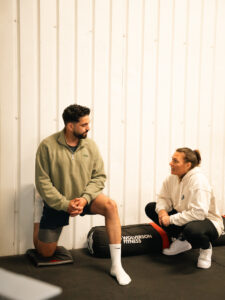
I am a chiropractor.
I have the degree, the clinical hours, the continuing professional development, and deep respect for the science that underpins this work.
The research and training that form the foundation of chiropractic and rehabilitation practice genuinely matter, and I would not practise without them.
And I also know that some of the most important things I understand about human bodies, I learned from being inside one under pressure.
The Athlete’s Body: A Different Landscape
Athlete bodies are not the same as resting bodies.
This sounds obvious when you say it out loud, but it has profound implications for how we assess and treat people in clinical practice.
An athlete’s nervous system is calibrated differently. Their pain thresholds, movement patterns, relationship to discomfort, and psychological responses to physical setbacks: all of these have been shaped by years of training in ways that a standard clinical assessment was not really designed to capture.
When I was competing, I experienced injury the way most athletes do. The frustration of being unable to train. The identity disruption of being sidelined. The particular kind of mental battle that comes from knowing exactly what your body should be capable of, only to feel it fall short. The tendency to underreport symptoms because admitting to pain feels like admitting to weakness.
I lived all of it. And sitting with that experience, really integrating it rather than moving past it, changed the way I practise in fundamental ways.
It changed the questions I ask. In a standard clinical intake, you might ask about the location, duration, and severity of pain. Those questions matter. But with an athlete, the more revealing questions are often different: what does your training week actually look like? How are you sleeping? What happens to this problem when competitive pressure increases? What does your inner monologue sound like on a bad training day?
These questions open up a picture that the clinical questions alone do not access.
The Importance of Trust
It also changed how I think about trust in the clinical relationship. Athletes have often learned, through the culture of sport, to manage their own discomfort quietly and to present as more functional than they feel.
Building the kind of rapport that allows someone to be honest about what is actually going on requires a practitioner who clearly understands that world. Lived experience creates a shortcut to that trust that is genuinely hard to replicate through textbook knowledge alone.
The Emotional Side of Recovery
And it changed how I hold the emotional dimension of injury. Pain is not just a physical experience. For an athlete, it is tangled up with identity, with purpose, with belonging.
The clinic that only addresses the structural issue is addressing part of the picture. The practitioner who can hold all of it—the body, the psychology, the performance context—gives the person in front of them a fundamentally different experience of care.
This is what I bring to my talks and workshops: not just clinical knowledge, but the integration of clinical knowledge with lived athletic experience. The combination produces a perspective that is, I think, genuinely distinct.
And it shapes everything from how I assess a patient to how I design a workshop to how I mentor a practitioner.
The body is not separate from the person inside it, and the best clinical work never forgets that.
If you’re a practitioner or coach who wants to integrate human experience with clinical expertise, whether in your own recovery, practice, or professional development, I invite you to connect.
Join a workshop, reach out about mentorship, or start a conversation about what truly holistic care can look like.